Tuesday, September 6, 2011

Marriage in Mochudi

So, this past weekend I went to a village called Mochudi about an hour away from Gaborone for my friend Grinni's aunt's wedding with a couple friends, Fidelia and Martha. We left on Friday evening from the university, but were running very late because we had been waiting for two of Grinni's friends for over an hour. Frustrated, we eventually gave up and left without them. There is a phenomenon here that people call "Africa Time," which is essentially the same concept as "Island Time," where people tend to take their time doing things and will often show up late to gatherings. I think that these girls were even later than the socially accepted and expected lateness because my friend was certainly livid. She was worried the whole time that her mother was going to yell at her when we finally did arrive.

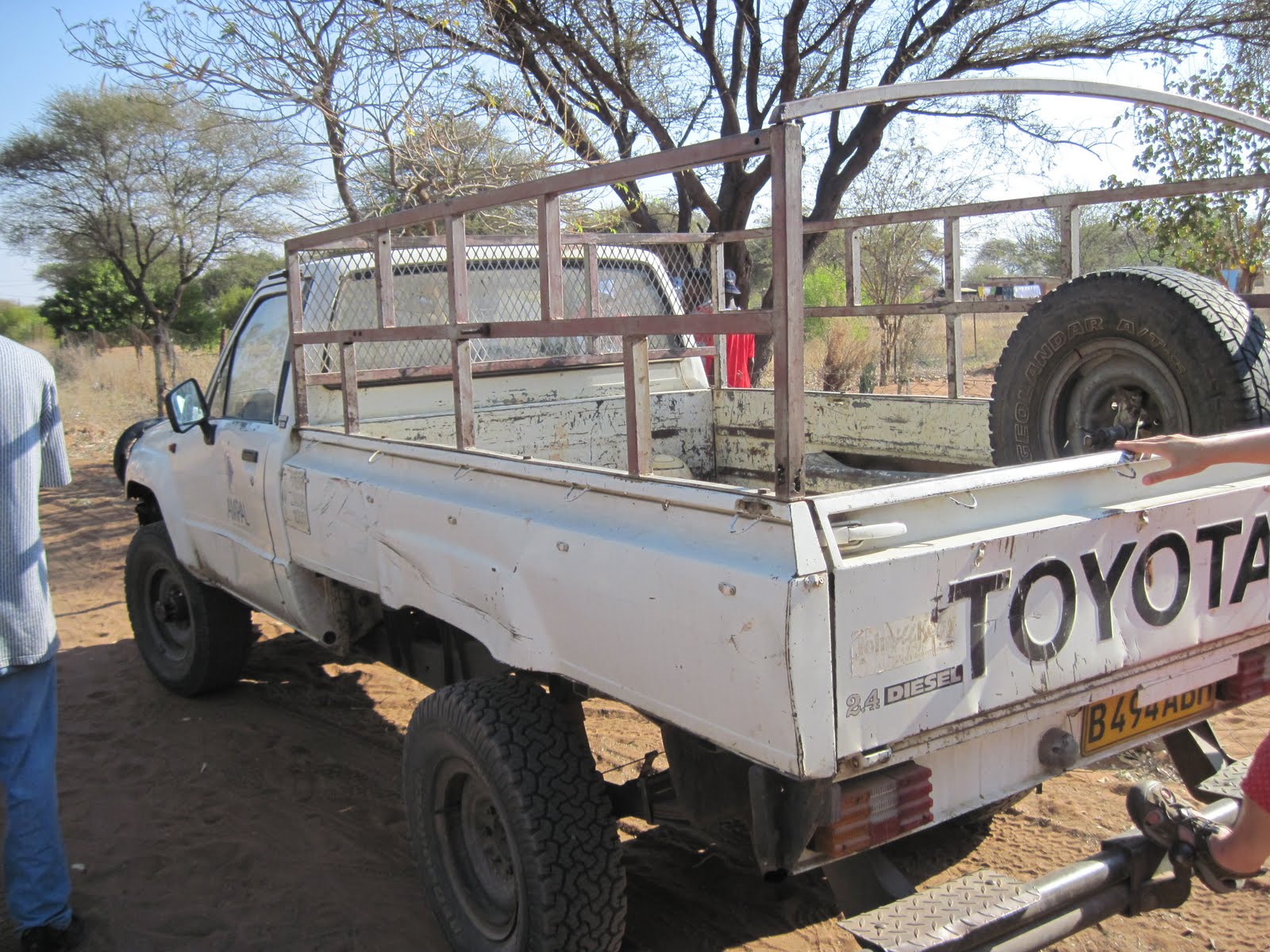
The form of transport to the wedding was a very old truck owned by the Rotatract Club, endearingly called  "The Anti-Christ." This endearment undoubtedly comes from the comfortable and secure feelings it inspires in its passengers, especially those occupants riding in the bed of the truck. Further evidence of its evil intentions is that it ripped my favorite dress when I was sitting in the back. Grinni assures me that it can be fixed, I just have to think more like an African.
This picture does not really capture the full character of the truck, but I am sure you can appreciate "The Anti-Christ," from my description.
When we arrived at the house around 8, it was after a long, cold ride in "The Anti-Christ." I was glad to finally stop moving and feel warm again--the coldest thing was the sharp breeze that just goes right through your clothes like needles. Grinni had warned us that she had a very large family. Her grandmother had fourteen children, then of course these children all had at least three or four (usually more) children of their own. This meant that there might be about 120 people at the house when we arrived. As we pulled into the house, Grinni laid on the horn to attract everyone's attention and announce our presence. There must have been about forty children waiting when we got there and everyone wanted to meet the strangers. Grinni's mother made us feel so welcome and seemed genuinely happy to have us there. When she hugged me in greeting, she picked me up off the ground and shook me. It has been a very long time since a woman has picked me up and it made me feel almost like a child again. I shook hands with the grandmother, who really blossomed into something of a character. She took to telling us that she loved us and called us her, "chummies." The children also came over and wanted to shake our hands and practice their English with us. When I turned my back to them, I felt someone touching my hair. It was one of the girls who had jumped up to feel it out of curiosity. I think that they were daring each other to because I happened a few more times until I leaned down and invited them to touch it.

After settling in, we got into the work of cooking. All the women of the family were preparing the meal for the wedding tomorrow. Some of them even planned to stay awake all night to finish everything. Our work (given to us for being late) was to dice the butternut squash. They were going to cook it for a very long time and mash it. After an hour of so of careful cutting, we were given tea and made to sit around the fire. Many of the people there did not speak English; we were told, too, that they were nervous to talk to us because they did not speak English. But everyone was very friendly and welcoming, even if they could not truly speak to us. Then some of the children were playing House music and practicing a dance that they planned to perform at the wedding. When we went over to watch them and try to learn, Grinni told them something in Setswana and immediately three boys grabbed my arms to claim me as their dance student. My teacher looked about nine or ten, but he spoke English very well and taught me the two dances that they had prepared. Each step had its own name, which made remembering them easier; they were also based on a four beat system. The dance was supposed to be in a line, so each cycle of the dance took you forward more. and taken to Grinni's mother's house, which was very close. We stayed the night there, but the whole house was active all night, cleaning, cooking, and preparing other things for the wedding.

We woke up early and went back to the grandmother's house to help cook. Our job that day was to peel, wash, and grate carrots. We stopped for a while to eat our breakfast of sorghum porridge, which I learned that they ferment so that the grain keeps longer.  It tastes like a hearty grain with a lemony taste. The best way to eat it is with milk and sugar, though Batswana also eat it with meat. We then went back to the house to change into the traditional dresses we were loaned and help the wedding party get ready.
This is the maid of honor.
Grinni, her aunt the bride, and the maid of honor.


From the left: Grinni's father, Martha, Fidelia, Mimi, Me, and Grinni.
Once everyone was ready, the bride came out of the house while the wedding party chanted and sang in Setswana. She was led out to her new husband, where they linked arms and also marched a bit around the yard. The singing continued as we all pilled into a combie and the bride went into a car. We drove back to the grandmother's house honking the car horns so everyone in the village knew that there was a wedding that day.
Everyone greeted the wedding party at the gate, taking pictures and trying to get a look at the bride. The grandfather met the wedding party at the gate and said something in Setswana, lifting his cane and shouting into the crowd.
Here is the grandfather greeting the wedding party.
Then the wedding party went into the tent while the rest of the family prepared to serve lunch. There must have been about two hundred guests there, possibly more. We helped serve the lunch to everyone, fireman style in a long line from the serving table around the yard. It was an interesting way of doing things because in the US we would have everyone line up and wait for the food instead of bothering to serve lunch directly to everyone. I liked it, thought, because it shows an extra effort put into hospitality, an African standard.

Then after getting pictures with everyone, we had to leave to get to a braai (barbeque) with a charity group we joined at school, the Rotaract Club (a subdivision of the Rotary Club). It was a fun ride back to Gaborone because the weather was nice and warm, so the wind felt wonderful. All in all, it was a wonderful twenty-four hours in Mochudi. Grinni has told us that next time we go back, her mother is going to make us slaughter a chicken and cook it up. I've never had freshly killed chicken before!

The wedding tent.

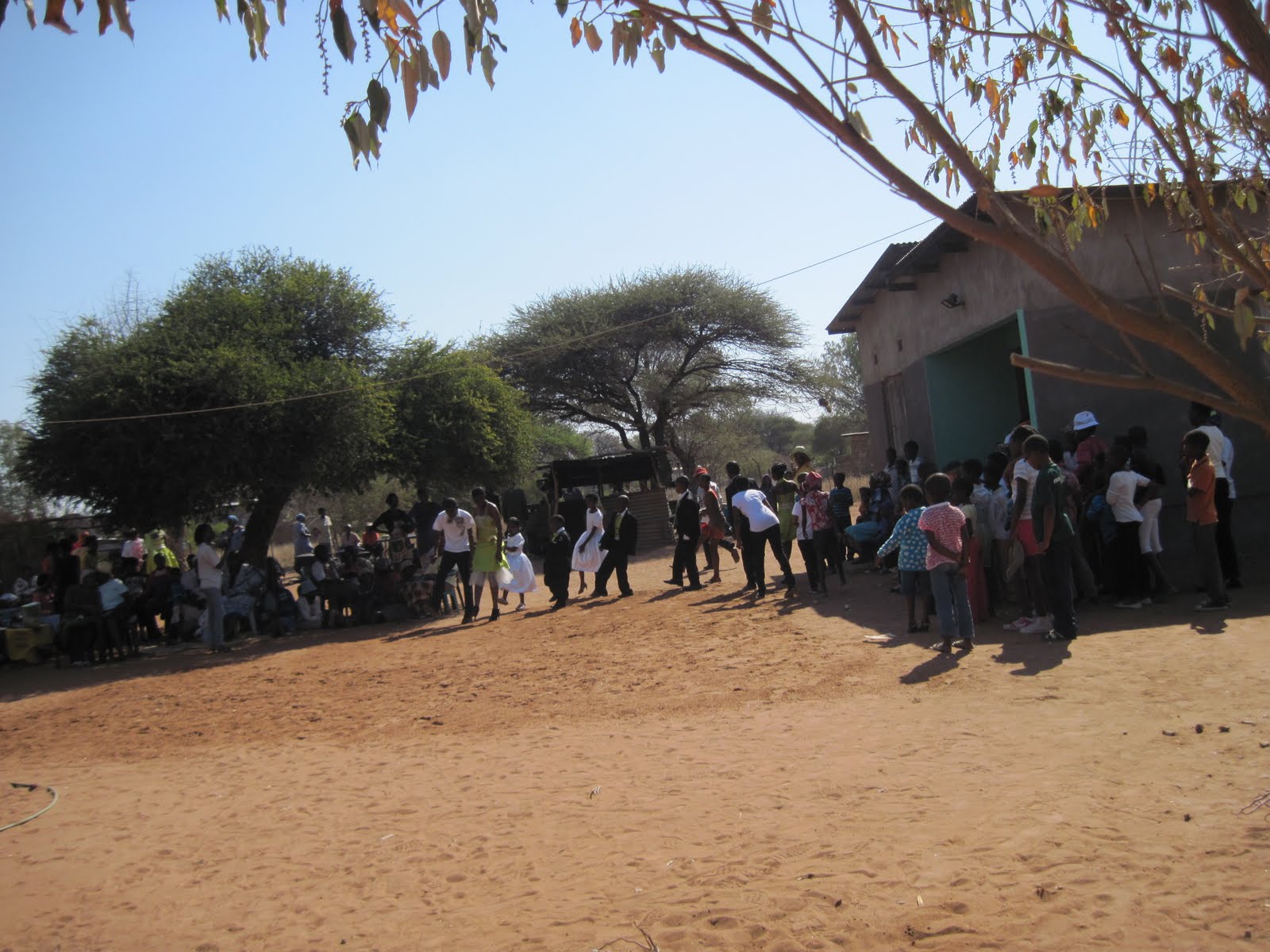
Some of the children organized a dance as entertainment for the wedding. Most of them were matching and everyone looked very sharp!

A view of the yard and guests.

A view as we pulled up to the house with the wedding party.


Monday, August 22, 2011

Cultural Excursion to Kanye and Manyana (Aug 13-14)

This past weekend, about fifty of the international students went on an arranged "Cultural Excursion" to visit a kgotla (public meeting place in a community), historical rock paintings, a game park, and the Livingstone tree. We stayed overnight in a village and were told some things about traditional life in an African village. This traditional life does not really exist anymore for Batswana. Many things began to change after Botswana achieved independence in 1966 and began to rapidly develop economically with the discovery of diamonds the following year. As is the case for many nations, people moved from the rural areas to the cities in search of jobs and adopted more modern views about marriage, social roles, and family.

Some traditions do remain, however. One example is that in a kgotla, women have to wear skirts that cover their knees in the meeting place. This was a bit of an interesting thing to prepare for because the kgotla visit was one of the first things we did on Saturday morning. The bus arrived at the village and most of the girls then had to struggle into their long skirts or dresses in an awkward fashion. During the visit, we also learned that the practice of paying a bride price at a marriage is still common, the standard for this particular clan being eight cows and a goat. It is not seen as "buying the bride," per se, but as showing appreciation to the bride's family for raising such a good woman. Some of the other traditions regarding gender were that certain chairs made from leather and wood were reserved for only men (no other reason was given, just that they were for men) and men are always served first. One benefit of the sexism for women is that if they are convicted of a crime, they cannot be caned because we are considered too delicate. The only punishments available to us are fines and jail time. Here are some pictures of the compound (you can click on them to make them bigger):
The thatch roofed building is the kgotla where all the meetings of the village take place, including weddings, trials, and such. I'm not sure what the large modern building is, but they had a conference room and a statue of a crocodile.

This is the group walking towards the kgotla.
This is a crocodile. I'm not sure if "Thy will be done," is a national slogan of some sort, but the picture behind the statue is Botswana's president, Ian Khama. Many stores and businesses have his picture hanging on their wall. Interestingly, Ian Khama is the grandson of the first president of Botswana, Seretse Khama.
That's me in my long, kgotla-friendly dress.

After the kgotla, we went to see the statue of one of the famous kgosi of the village. It had just been unveiled the day before. The statue overlooks the whole valley, so that the late kgosi, Kgosi Bathoen II, can watch over his territory.
Statue of the late Kgosi Bathoen II.

The next stop was the reservoir on the way to lunch. Apparently it was built from 1939 to 1941 by the community, not by a government organization. Now, the water is very much polluted, so people are not supposed to fish (though they do anyway) or swim in the water. Not that one would want to swim here because of all the trash left by wanton partiers on the shore and floating in the water. Below, you can see the beer bottles bobbing in the water. Also, the trees that were planted along the shore are not native to Botswana; they are invasive and compete with native plants.


Next, we had lunch at a hotel that was playing CSI Miami on the television (American media is everywhere, especially the music). Then we headed off to see some old rock paintings and a cave that supposedly had housed a pregnant wife of the chief during a war between tribes in 1851. My friend Martha and I crawled a bit into the cave before Tebogo (one of the Motswana that work in the International Student office) got nervous and told us to come out.
Walking up to the paintings.

This is our guide explaining the paintings to the group.
This is an "abstract" painting, the meaning of which researchers have been unable to identify. 


That loop is the symbol for a snake.

Here is an antelope of some sort. The horns are faintly discernible.


These are people! The one on the left is carrying something on his/her back.
These are some sort of animal, the guide said they have not been identified because of the strange way the heads are shaped.
This is inside the cave that the pregnant wife of the chief lived in for a few months. It is named after her.
The roots of this tree grow about 30 feet down the side of the rocks. Its hard to capture how amazing that is on a camera, but it was really neat to see in person.

 After the rock paintings, we went to the Livingstone Tree under which the missionary Livingstone was supposed to have come to preach and convert the locals. One of my friends told me that Livingstone himself never actually converted as many people as he is credited for. He only converted one man, who then went and converted most of the people in the area. So, indirectly he is famous for his work. The guide said that he does not know how old this tree actually is, but he knows that it was large in 1850 when Livingstone saw it. It is a wild fig tree, as I remember. Sadly, the tree looks like it is not in very good shape. The leaves do not look very healthy and many of the branches are cracked or breaking. It is still a very neat looking tree, though!

This is the center of the tree. Its all cracked, as you can see, and doesn't seem that healthy.

Moe took a picture of me.
This is Moe. He's a vegan and works in the international office.
This is a close up of the leaves.
Next, we went to a "cultural village," where the residents sort of put on a show for us about traditional practices in an African village. The most entertaining part of the whole presentation was when we were taught traditional dances. One of the men brought me out into the center and had me doing a twirling sort of dance with him. Then one of the older ladies dragged me out again later to teach me a harvest dance. The funniest dance was actually fairly raunchy; it was a dance meant for teenage girls just coming into their beauty. It involved the girl backing up towards the men with her hands on her hips, then turning around to face them with her hands placed on the side of her breasts with her fingers splayed like feathers.

(This post isn't quite finished, but I will post it now and add more later.)


Sunday, August 14, 2011

"Las Vegas" Living

Several people have been wondering what my room at University of Botswana looks like, so I took some pictures to post here. The hostels where the international students are living on campus is nicknamed "Las Vegas." I have heard two reasons for this nickname. The first one was that these were the nicest dorms on campus because they have everything (hot water, internet, more space, etc.) just like Las Vegas. Second was that just like the American city, "What happens in Vegas, stays in Vegas."


My board and Botswana flag I got at the Botswana-Kenya friendly match last week!

The best thing about this bed is that its super long. Also, the pallet has an African animal themed print!

Super organized closet. You know.

Front door and a peek at my roommate's side of the room. Its a mirror of mine, except more put together.

Desk and shelves.


So, apparently people like to steal the shower heads from the showers. As a result, most showers don't have them, like ours. The stream that comes out is very hard, which is nice on your shoulders.


Tuesday, August 9, 2011

Canvasing Gaborone from Kgale Hill

Well, my eyes are closed, but hey--it is a long hike up there to retake it. In the background is the Gaborone Dam and reservoir.
So on Saturday, eight friends and I met in the morning to hike Kgale Hill, which overlooks all of Gaborone and the Gaborone Dam. It took us about two hours to get from the University to Kgale Hill because we had to catch a combie on the main road off campus, take it to the station, walk over the flyover (overpass), and find our next route. We then had to split up to fit into the Kgale View 3 route combies and meet at Game City. From there, we wandered around the hill for about half an hour before finally stumbling upon the right trail. Near the trail head are the quarries, where they have been mining for a while. I am not sure what they are mining, but it must mostly be finished with because there is not that much activity. The climb up the hill was fairly steep and involved more rock climbing than hiking. It was a beautiful view though! I wish I could post the video I took from the top, but I think that my school has blocked any and all video uploads. Here are pictures, though:


Here is Gaborone!
There is Kgale Hill in the background and the white van driving away is a combie. And see, KFC is even in Botswana! Except it is considered an expensive place to eat.
Kgale Hill


Interesting graffiti on the road.

You can't really tell from the picture, but this tree looks like it grew between two rocks, then tipped over and grew around this rock. The tree looks ancient, too.

The rooty underside...

This is the cell phone tower at the top.


Thursday, August 4, 2011

Culture Shock and Cold Weather


I have now officially been here in Botswana for about a week and I have to say, it is quite different from what I expected, yet completely does not surprise me. Many Batswana are very nice, polite, and helpful as all the travel books and websites claim. Others, though, are not so nice. I suppose its like the opposite of New York where the preconceived notion is that all New Yorkers are very rude--many are, but some are quite decent and polite people.


Here is a view of campus from my dorm (called "hostels" here). Starting from the right, you can see the refectory (dining hall), laundry station, and the student center. Also in the background is the stadium. Farther back is most of the rest of campus. Our dorms are on the very edge.
This is the overview of my dorm's courtyard. The official name is block 480, but everyone calls these dorms "Las Vegas" because they think it has everything good: hot water, internet, etc. I think they are newer dorms, too, than the rest of the undergraduate dorms.
This is my common room in my dorm. I do not have a picture of my actual room yet because its really messy--I have not quite settled in just yet.


One of the first things a person reading about Botswana should know is that this country is doing much better than most other parts of Africa. Violent crime is fairly low, especially compared to South Africa, though theft is fairly common. Gaborone especially is the most developed city in Botswana, being the capital and hub of trade in the country. The population of the city is only about 200,000 people in a country of about 1.2 million. There are few tall buildings to be found in the city, besides near the Parliament building, so it has more the feel of extended suburbs. The diamond industry, which is both government and privately owned, generates most of the income of the country. The government is very socially progressive, supporting extensive social welfare programs with the income from the diamond trade. Since the recession in 2008, diamond sales are down by almost 90%, which has left the government in debt. Some people are concerned that the government will not long be able to support all of these programs. For more about the basic facts of Botswana, check out the State Department's country profile: http://www.state.gov/r/pa/ei/bgn/1830.htm


All of the people from the international education office keep telling us to be careful, don't walk around alone at night or alone anytime off campus; be careful with your belongings because people will steal from you in a heartbeat; be careful with who you bring into your room because they might just be making friends with you to rob you; and don't answer your door if you don't recognize the person's voice because they might be there to knock you out and rob you. Then on the other hand, we are told that Batswana are friendly and honest people, so we should feel free to go up to them and chat; we should avoid always hanging out with other Americans and international students because we will miss a lot of the culture. These two opposing pieces of advice really have me confused because I want to make friends with Batswana, but everything that I am being told seems designed to make me distrust them. 


I am becoming close friends with my roommate now and she is one of my favorite people here so far. She is a dream to live with because she is quiet and considerate. Also she has been very helpful to me so far in learning how to get around the city, especially how to use the combie system. Combies are the main form of public transportation. They are white mini vans that are privately owned and opperated and run along specific routes in the city. You have to know which route goes by your particular destination and choose that van. Sometime, you have to switch combies at a certain place so you can go in the right direction. The fare for the combies are very reasonable, too, being only three pula per a ride, which amounts to less than fifty cents American. Everyone pays as they leave the van, dropping the coins into the driver's hand or passing it up to him via other passengers. I love riding in the combies for a few reasons. First, the international students from UB (University of Botswana) are virtually the only foreigners to ride them. Then, we also get to meet other Batswana from all over Gaborone.


If you know me, you probably know also that I love tea. So obviously, when I got here I had to set myself up with a tea station in a my room. This was a bit more complicated than I thought it would be because I had to search around Gaborone for an appropriate converter to use. The one I brought I thought did not work--that is, until my roommate told me I had to know the African trick of pushing down the third hole with a pen so that the other prongs would go in. So the converter I brought worked (because Botswana mostly uses UK plugs) but I still had to buy another one because my kettle used the round plugs that South Africa uses. Essentially, my appliances use three different plugs: European (for my cell phone), American (for my laptop), and South African (for my kettle). Everything is sorted out, now, but as you can see inspired the name of my blog. That, and there was alliteration, which I very much enjoy. It ties the title together (<--Yep, see?).
This here is my tea station.

And this here is my elaborate converter system!
One thing I did not expect is my dorm room not having heating. At night, it gets very cold here, almost to freezing. The first two nights were rough because we did not have a heater. Luckily, the blankets were very warm. The next night, I happily came back to the room to find it relatively toasty because my roommate brought a heater. It is a lifesaver here at night. I am the envy of the rest of the international students because most do not have them.


The beautiful heater, with its happy warm glow (makes me feel warm and fuzzy outside!).
There is so much more to say about the country so far, but I will save it for the next post. Classes have not really started yet either because the first week is the Add/Drop period and most students are still trying to figure out scheduling. Usually the first day, neither the students or the professor will show up for class. If they do, they pass out the syllabus and dismiss us. Next week, the classes will start more seriously, so I will have something substantial to say.